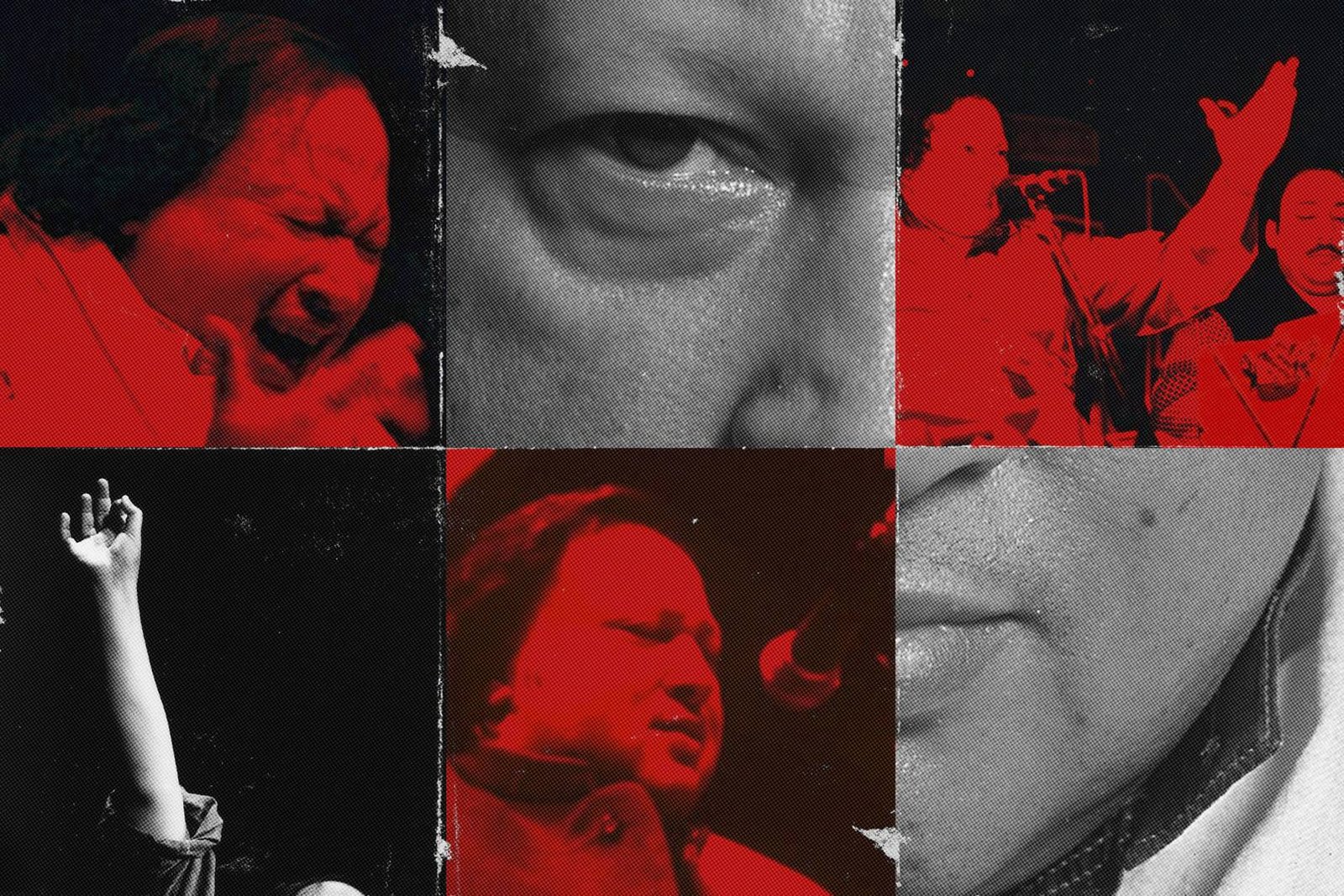
In a London hospital bed, on August 16, 1997, a forty-eight-year-old man's heart stopped. His kidneys and liver were already failing, he had stopped in London on his way from Lahore to Los Angeles for a kidney transplant, and there, at Cromwell Hospital, his body gave out . It was late at night in Pakistan. But before dawn, hundreds of people had gathered in front of that house in Lahore, no one knew exactly what to do, only that a voice had stopped that had been in the air of their city for many years.
Today, thirty-nine years after her death, her voice has not stopped. More than one crore people listen to Nusrat Fateh Ali Khan’s songs every month on Spotify, the majority of whom were born after her death. Fragments of her “Afreen Afreen” or “Mere Rashke Qamar” play on Instagram reels in a context that has no direct connection to the Qawwali or Sufi tradition. The question is not so simple. How does an artist continue to redraw the geography of music, even after her own death?
What is most talked about about Nusrat's singing is her six-septal range and her ability to sing for hours on end. But this description does not touch on the real mystery of her music. At the heart of Nusrat's singing was a kind of controlled explosion, where she would repeatedly break down and rebuild a sargam phrase, changing it slightly with each repetition to take the listener into a kind of trance. This technique is called sargam, tanpalta or laykar, a technology borrowed from khayal-gakir, but Nusrat used it within the emotional framework of qawwali, creating a new space between classical music and devotional performance.
What seemed most unfamiliar to Western listeners about her voice was the increasing intensity, where the songs began almost in a colloquial tone, gradually intensifying to a point that in Sufi terms is called “hal,” a state of spiritual ecstasy. Peter Gabriel later said that he had not found anyone else, not since Otis Redding, who could convey the kind of feeling Nusrat’s voice could convey. This comparison is significant, because Nusrat’s qawwali has no apparent similarity to Redding’s soul music, no language, no tradition. The only similarity is in one place, where the voice transcends technique and reaches directly to the nerves.
Before Nusrat
Qawwali has its roots in the 13th century, with the help of Amir Khusro, who created a new form of Sufi shrine singing that combined Persian, Arabic and Indian musical traditions. “Qawwal Bachchon Ka Gharana”, Nusrat’s family singing lineage, claims to be the direct heirs to that Khusro tradition, which began with the story of a group of twelve children. For over six hundred years, the family has sung in the shrines of Delhi and Punjab, father to son, master to disciple, an oral tradition that has never been fully written down.
Ghazal, however, has taken a different path than Qawwali. Born from the Arabic tradition of Persian poetry, ghazal is essentially a poetic form that oscillates between the lament of a single lover, Ishq-e-Majazi or human love, and Ishq-e-Haqqi or divine love, where each verse is unique but the entire poem is bound by a single emotion. From Mir Taqi Mir, Mirza Ghalib to Faiz Ahmed Faiz, this genre has become one of the richest branches of Urdu-Persian literature. Artists like Mehdi Hassan, Begum Akhtar, Ghulam Ali established ghazal as a genre of music. Restrained, elegant, and simply put, primarily for a highly educated Urdu-speaking audience.
Qawwali and Ghazal, therefore, used the same language, the same poetic repertoire, but their social positions were different. Qawwali was a courtly, communal, almost physical experience. Ghazal was a mehfil, personal, restrained. This is where Nusrat's importance begins, she begins to break down the wall between the two.
And Nusrat
Nusrat never claimed to be a ghazal singer. She was, first and foremost, a qawwal. But in her performances, she consistently brought the poetic repertoire of ghazals within the framework of qawwali, so that what was created was not bound to any particular genre. In performances like “Tumhe Dilgi Bhulana Padega” or “Sanso Ki Mala,” the personal detachment of ghazals and the collective exuberance of qawwali fused together.
This mix was his greatest intervention. In traditional Qawwali, poetry was essentially a spiritual messenger, its rhythm and the power of repetition more important than the meaning of the words. Nusrat did not break this structure, but she introduced the subtlety of ghazal into it, making each word feel its weight, dragging out a single line for several minutes to bring out all its possible emotional layers. In this way, she forced the listener to look back at the lyrics, not just to be swept away by the flow of the melody.
The main themes of ghazals are love, separation, waiting, surrender. These themes can be read as secular love stories, while in Sufi philosophy the same words can be read as a lover's desire for God, this duality is what gives ghazals their power. Nusrat's voice deepened this duality, as she often kept both layers active in the same performance, sometimes giving priority to one, sometimes the other, leaving the rest to the listener's interpretation.
This is where her role became most important for the Urdu-Persian poetry world. The culture of listening to ghazals at a mehfil was limited to a certain class, a highly educated, Urdu-speaking, literature-loving group. When Nusrat sang the same poem in a gathering of qawwalis, in an almost festive style, that poem was no longer confined to the four walls of the mehfil. An audience that did not understand Urdu, did not know the references to Persian sher, could also absorb the emotion of the poem from the intensity of Nusrat's voice. In this way, an elite literary tradition was able to transcend its linguistic boundaries, without translation.
Across the border
Nusrat's first major performance at the UK's Omad Festival in 1985 was considered the starting point of her international journey. It was the first time she had sung in front of a Western audience. Soon after that performance, she was signed to Peter Gabriel's Real World Records label. And in 1989, her voice was added to Gabriel's album "Passion", which was used in the soundtrack of Martin Scorsese's film "The Last Temptation of Christ". A Pakistani qawwal and a British rock star, two completely different musical traditions, meet in a Hollywood film based on Christian religious themes.
This connection was not limited to a film soundtrack. Nusrat's voice found its way onto the soundtracks of Oliver Stone's "Natural Born Killers" and Tim Robbins' "Dead Man Walking" in later years. One of her songs on "Dead Man Walking" was a collaboration with Pearl Jam's Eddie Vedder, an unusual yet effective fusion of rock and qawwali. Vedder himself later called Nusrat his "Elvis," suggesting that this voice had become a kind of standard of authenticity within Western rock music as well.
But the most important connection was with Canadian producer and guitarist Michael Brook. At the end of a session at Real World Studios, Gabriel said lightly, "If only Nusrat could sing something with Western instruments." Nusrat then, almost whimsically, played a sargam on the harmonium, which later became the basis for the song "Must Must." The album "Must Must" released in 1990, Nusrat's voice blended with Brook's guitar and electronic textures to create the first major qawwali-fusion record.
The importance of this album must be understood beyond its commercial success. Here, the long, meditative structures of qawwali were attempted to be inserted into the short, structured mold of Western production, and Nusrat stood on her own terms against that pressure. Brooke later admitted that he understood that Nusrat reached her highest heights when she was given enough time to improvise, as the short backing tracks would have limited her singing. On their second collaboration, 1996's "Night Song," Brooke applied this learning to create long, open structures in which Nusrat could sing more freely. The album received a Grammy nomination and Billboard called it "a timeless record."
Nusrat is often seen as a representative of “world music,” a category that makes her music understandable to the Western market, but at the same time leaves her in a kind of marginal, outsider position. What happened in reality is more complex than this category. Nusrat did not adapt herself to Western music, but rather forced Western producers to understand the logic of her singing, to accept her long breaths, her unexpected turns, the structure of her controlled madness. This is why her fusion records still feel old, because the compromises in them were not one-sided.
A.R. Rahman, himself known for his fusion of classical and Western elements in Indian film music, cites Nusrat as one of his major influences . Platforms like Coke Studio, which bring Pakistani folk and classical music to a new generation by blending them with contemporary productions, draw their aesthetic heavily from Nusrat’s legacy. Jeff Buckley, an American musician who himself passed away just three months before Nusrat, described her as “godlike.”
After Nusrat
After Nusrat's death, her nephew Rahat Fateh Ali Khan took up the family singing tradition, building a career spanning from Bollywood to Coke Studio. But Rahat himself has repeatedly said that comparisons with his uncle are meaningless, because the mesmerizing quality of Nusrat's singing cannot be replicated.
In 2024, a “lost album” called “ Chain of Light ” was released from the archives of Real World Records, featuring some traditional qawwali performances recorded in 1990 but never released. The fact that a new album by a deceased artist has been released from thirty-four-year-old tapes, and that the album has been widely discussed in the music industry, suggests that Nusrat’s relevance is not a matter of nostalgia. Her repertoire has not yet been exhausted, nor has her audience. In the age of digital platforms, this relevance has a different logic. Spotify or YouTube algorithms do not reward long, meditative performances, but there are countless moments in Nusrat’s singing that do not lose their intensity even when cut into a few seconds, a melody, a cry-like tone, a sudden change of rhythm.
So let's get back to the original question. Did Nusrat popularize ghazals, or did she change the experience of listening to ghazals? The answer probably leans towards the latter. Popularity is a quantitative change, more people started listening. But what Nusrat did was qualitative, she bridged the gap between ghazals and qawwali, transformed personal separation into collective celebration, transformed an elite poetic genre into a physical experience that could be experienced without knowing the language.
It had its price. Some critics felt that albums like “Night Song” strayed too far from traditional qawwali,¹⁸ questioning how much purity could be sacrificed for a wider audience. This tension complicates Nusrat’s work, but it does not diminish her. Rather, it shows that she was a conscious artist, a person who walked consciously between tradition and experimentation, not some innocent genius who accidentally became world-famous.
Nusrat's tomb in Faisalabad's Jang Road graveyard is still a place of pilgrimage for musicians. But her real tomb is probably not in any specific place. It is spread in the headphones of a young listener, who may not know who actually wrote "Mere Roshke Kamar", from which century the poetry emerged. It is spread in some new production of Coke Studio, in the bend of a tune by A. R. Rahman, or in the voice of Rahat Fateh Ali Khan. The artist dies, but the cultural life of her voice does not stop, but rather continues to change its shape, creating new meanings in the ears of a new generation. Nusrat Fateh Ali Khan has proven this.