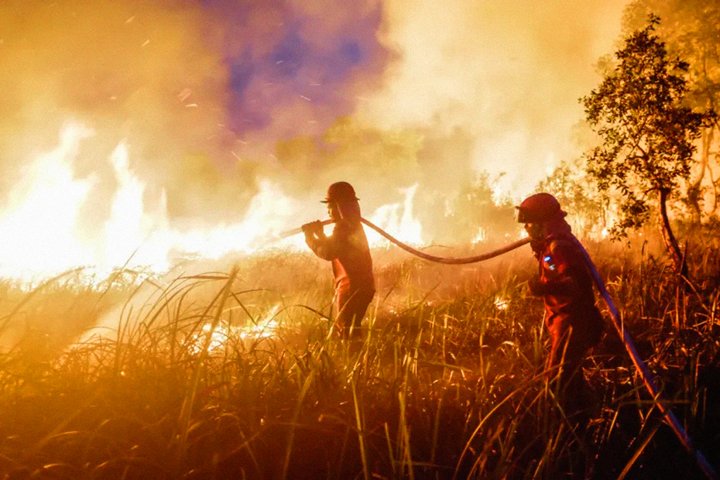
The sky over Pontianak takes on a certain hue in the last week of August, darker than grey, paler than orange. Schools in the capital of West Kalimantan are closed indefinitely, classes have moved online, Covid-like, and city dwellers are living their lives with their windows closed, breathing in a smog that originated in their own country but whose effects extend beyond the border. According to Manggaab , the smog began to drift into western Sarawak from West Kalimantan in July, and the situation has only gotten worse since then.
On August 27, the ASEAN Specialized Meteorological Center raised the regional smog alert to its highest level, Level 3, for the South ASEAN region. Smoke from hundreds of fires in Kalimantan and Sumatra had reached Malaysia, Brunei Darussalam and as far away as the Philippines. The Malay Mail reported that the air pollution index in Serian, Sarawak, reached 475, well above the hazardous level. In Brunei's capital, Bandar Seri Begawan, the concentration of fine particulate matter PM2.5 in the air exceeded almost thirteen times the safe level set by the World Health Organization, prompting the country's health ministry to issue a public health alert. Singapore was also preparing to deal with possible smog.
This scenario is not new. Southeast Asia has been trying to combat smog for decades, yet every few years the region finds itself breathing in the same smog. The problem is transboundary, yet the jurisdiction to solve it largely remains within national borders.
An old guest
Historical records show that smoke from Indonesia's fires has been affecting neighboring countries since at least the 1970s. The 1997 and 2015 fires were two of the deadliest in the region's history. The 2015 crisis was so severe that more than half a million people were hospitalized with acute respiratory infections, according to a United Nations project document , and the damage to Indonesia's economy amounted to about $16 billion.
Scientists have found a complex mix of human activity and environmental conditions behind this recurrence. Burning to clear land is a starting point, but the real danger lies in the drying up of endangered wetlands, the peatlands. Once dry, the peat burns underground, creating thick, persistent smoke that is almost impossible to extinguish. Weather patterns like El Niño make things worse, with prolonged dry seasons drying out vegetation and peatlands, making it easier for fires to spread. In this crisis, lower-than-normal rainfall has also kept the fires alive. According to ABC News , more than 200,000 hectares of forest have burned across Indonesia since the start of the year, an area about three times the size of Singapore, and about 95,000 hectares have burned in July alone.
This means that responding to fires after they occur will not solve this problem. Prevention, land management, and law enforcement are all equally important, perhaps even more so than extinguishing them.
Where liability begins
Indonesia is at the heart of the problem, as most of the smoke that crosses its borders originates in its own territory, particularly on the islands of Sumatra and Kalimantan. This reality places a clear responsibility on the Indonesian government to prevent fires, enforce environmental laws, and hold responsible individuals or institutions accountable. Indonesia has both the laws and the institutions. After the devastating fires of 2015, President Joko Widodo established the peat restoration agency, Badan Restorasi Gambut, or BRG, in January 2016, with the goal of restoring more than six million acres of damaged peatland. An earlier report by Mongabay said the agency had done things like closing canals, restoring water levels, and planting new trees, but even the agency’s own leadership admitted that progress had not been as good as expected.
The challenge is not a lack of laws, but implementation. When land use, economic interests, local customs and extreme weather conditions all come together, it becomes difficult to translate rules into effective prevention. Indonesian authorities have once again promised legal action against those responsible for the fires, as they do every year. The question is not whether Indonesia should take action. The question is, is national action enough when the consequences are regional?
ASEAN has tried before.
ASEAN has recognized this problem for decades. In 1997, member countries adopted a Regional Haze Action Plan, aimed at strengthening prevention, monitoring and regional coordination. In 2002, they signed the ASEAN Agreement on Transboundary Haze Pollution, which , according to the Asian Development Bank, is the world's first regional framework that legally binds a group of countries to address pollution from land and forest fires.
But Indonesia was the last member state to ratify the agreement. According to documents from the US Library of Congress , the country's parliament ratified the agreement on September 16, 2014, twelve years after it was signed, and the ratification document was deposited with the ASEAN secretariat in January 2015. Researchers have argued that the agreement's processes remain limited because they reflect the so-called ASEAN model, a long-standing culture that prioritizes sovereignty and non-interference.
This is where a dilemma arises. The smog is regional, but the jurisdiction to address its causes remains largely within national borders. This is why ASEAN can share information, monitor and coordinate emergency responses, but struggles to hold member states fully accountable for this recurring pollution.
Can ASEAN do more?
ASEAN does not need to become a supranational authority to be effective. What is needed is a relatively pragmatic one.
First, the affected countries can use ASEAN diplomatic channels to demand stricter enforcement from Indonesia. This demand has already begun. According to a report by the AsiaNews Network , Malaysian Prime Minister Anwar Ibrahim said after a meeting with Brunei's Sultan Hassanal Bolkiah in Bandar Seri Begawan that both countries had chosen the ASEAN process as the best option. According to Anwar, they had chosen the ASEAN process as the best way forward. Malaysia then prepared to send a formal letter to Indonesia through the ASEAN Secretariat. By then, about 600 schools in Sarawak had been closed, affecting about 200,000 students.
Second, ASEAN can increase transparency. Regional sharing of fire data, smoke assessments, and government responses can make it easier to see where fires are burning and whether promises are being fulfilled.
Third, ASEAN could enhance practical cooperation, from early warning systems to joint firefighting and peatland management. The regional framework has long identified peat fires as a major driver of smog.
These steps will not replace Indonesia's responsibility. Rather, they will strengthen that responsibility.
ASEAN has shown that diplomacy can resolve regional crises, although its limitations are clear. In the Thailand-Cambodia border conflict, a Malaysian-led ceasefire and later a peace agreement were achieved in 2025, with Anwar positioning himself as an impartial mediator. But analysts remind us that this success was not the result of any institutional process within ASEAN, but rather a combination of personal diplomacy during Malaysia’s chairmanship and parallel pressure from the United States and China, and the renewed border conflict in December proved that peace was fragile. Environmental crises demand the same level of political attention, especially when their consequences extend beyond borders.
Responsibility is regional, but responsibility remains national.
The recurring haze exposes a deeper crisis in Southeast Asia, where national responsibility and regional consequences are not always easily reconciled. Indonesia must take the lead in putting out the fires within its own borders. But its neighbors cannot afford to sit around waiting for the next crisis, and ASEAN cannot afford to see another haze season as a normal occurrence.
The goal is not for ASEAN to put out every fire. The goal should be to strengthen regional cooperation so much that it becomes difficult to ignore the firefighting effort. After decades of smog, Southeast Asia may not need new agreements. It needs to implement what has already been signed.
Editorial note: This report is inspired by a recent article published in The Conversation by researcher Rifki Darmawan. However, all information used here has been re-verified by The Publish.